

Sony A7 V Review: Dynamic Range, Speed, and AI Power in a True Hybrid Body

The long-anticipated Sony A7 V has finally arrived, bringing one of the most significant generational upgrades to Sony’s core full-frame lineup. While it may look familiar on the outside, the internal redesign, new sensor architecture, and AI-driven processing elevate the A7 series to new territory—so much so that it’s already being referred to as a “baby A1 Mark II.”
Below is a full hands-on breakdown of its design, features, performance, and who this camera is truly built for.
Build and Handling
At first glance, the A7 V looks nearly identical to the A7 IV, but several meaningful design refinements make a noticeable difference in real-world use:
- Dimensions: 130.3 x 96.4 x 72.3 mm
- Weight: 695 g (37 g heavier than the A7 IV)
- New 3.2-inch 4-axis tilt touchscreen with double the resolution
- Two USB-C ports with 10 Gbps transfer capability
- Dual card slots: one SD UHS-II and one hybrid SD/CFexpress Type A
The new 4-axis screen is the standout physical update. Like the A7R V and A1 II, it can tilt independently even without the flip-out mechanism—making high, low, and side-angle shooting dramatically more convenient, especially when cables or L-brackets are attached.

New Sensor: Partially Stacked Exmor RS
Sony introduced a newly designed 33-megapixel partially stacked sensor, keeping the resolution of the A7 IV but enhancing performance significantly:
- 16 stops of dynamic range (up from 15 in previous generations)
- Higher readout speeds for burst shooting and video
- Support for composite RAW, blending multiple exposures into a single high-dynamic-range RAW file
This new sensor architecture positions the A7 V between the A7R V and A9 III in terms of speed and tonal performance—without the extreme price tag.
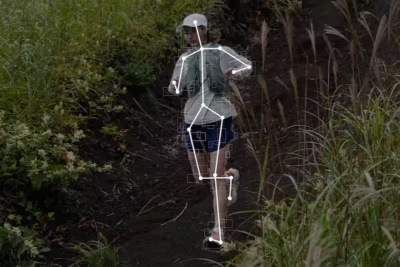
AI-Driven BIONZ XR2 Processor
For the first time, Sony has integrated both the traditional processor and the AI unit into a single powerful chip: BIONZ XR2.
This enables:
- More reliable subject recognition (humans, animals, birds, insects, cars, trains, planes)
- Faster and more precise eye-AF and tracking, even at high frame rates
- Improved auto white balance and color accuracy using scene and subject understanding
- 30 fps electronic burst shooting with blackout-free viewing
- 10 fps mechanical shutter speed
- Pre-capture function (first seen on the A9 III) to catch moments before you press the shutter
The camera also features 7.5 stops of in-body stabilization, pushing it into class-leading territory for handheld shooting.

Video Capabilities
The A7 V earns its “hybrid” label thanks to major video upgrades:
- 4K 60p with no crop (using the new 4K Angle-of-View Priority mode)
- 4K 120p in Super 35 mode
- 10-bit 4:2:2 color plus 8-bit options
- Dynamic Active Stabilization for smoother handheld footage (with a crop)
- AI-powered Auto-Framing for tracking moving subjects
From slow-motion wildlife footage to cinematic handheld work, the video performance clearly surpasses the A7 IV and places this camera well above its class.
Who Should Buy the Sony A7 V?
The A7 line has always been Sony’s “middle ground” camera—but this generation pushes that concept much further. Thanks to its mixed set of strengths, the A7 V is suitable for:
Photographers
- Portrait photographers: Better color processing and skin tones, especially in complex lighting
- Sport/action shooters: 30 fps bursts with improved AF success rate
- Wildlife shooters: Fast tracking, high-speed bursts, and animal recognition
- Landscape & architecture photographers: Expanded dynamic range, composite RAW, and long-exposure bulb timer
- Street photographers: More ergonomic tilting screen + silent high-speed shooting
Videographers
- 4K 60p no-crop, 4K 120p (S35), and excellent color profiles
- Improved stabilization and auto-framing help solo creators enormously
Hybrid Shooters (Photo + Video)
This is arguably the group Sony built the A7 V for. It can do nearly everything well without the cost or specialization of the A1, A7R V, or A7S III.
What We Liked
- 33 MP partially stacked sensor
- Strong AI-enhanced autofocus and color rendering
- High-quality 4-axis vari-angle screen
- 30 fps electronic burst shooting
- Crop-free 4K 60p video
What Could Be Better
- Only one CFexpress-compatible slot
- Slightly heavier than the previous generation

Final Verdict
The Sony A7 V is a major leap forward in Sony’s most important camera line. By blending high-speed performance, excellent video features, improved ergonomics, and state-of-the-art AI processing, it stands as one of the most versatile full-frame hybrid cameras available today.
If you need a single full-frame body that can do nearly everything—portraits, landscapes, weddings, sports, travel, and professional video—the A7 V might be the best value on the market right now.